The Facebook post talked about block trading, the kind of large stock trade that sounds as if ordinary people are being let into a room that used to be closed. The next step was a private group. Thai police say the group's job was to walk people onto a site and an app that were never a broker. The screen showed a profit. The way out was another fee.
Block trading, in this pitch, was a costume. The app was the till.
How it works
- A Facebook post talks about high returns from block trading. The return is the reason to leave Facebook and continue somewhere quieter.
- The chat moves to Line, where other "investors" encourage an account on eto-th.com and an app called ETO TH. The cheering is part of the shop. A stranger who is excited that you deposited is not a fellow customer.
- Deposits go into corporate accounts. The screen shows a profit. The profit is a number the app is willing to display.
- A withdrawal is met with another payment, for a tax, a release or a verification. The profit does not arrive. Police said the money then moved through banks, gateways and crypto, and that some of it bought houses, cars and watches in other people's names.
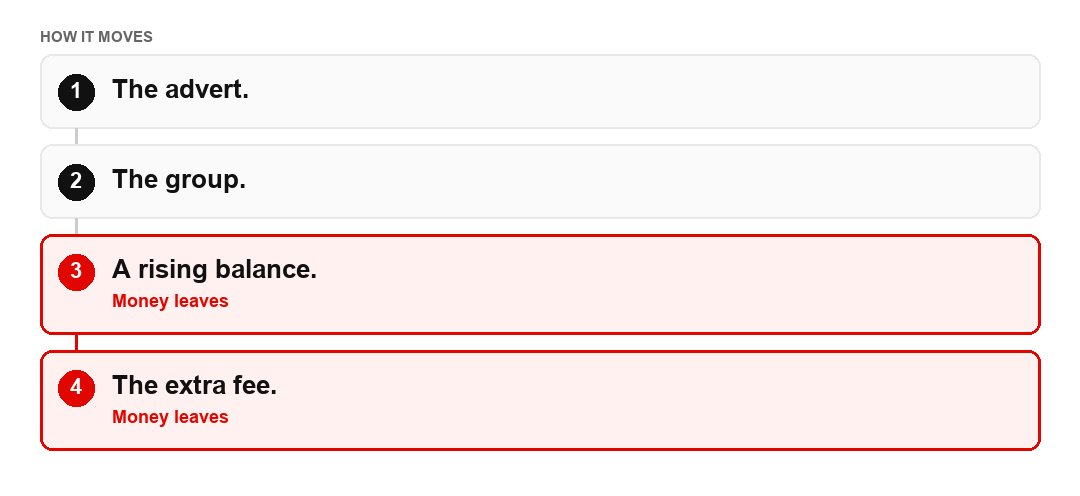
The extra fee is the moment to stop, and it is also the moment the screen is most convincing, because the balance is sitting there looking owed. Paying a tax to collect a profit you have never touched is paying the app again.
Signs and red flags
An investment that begins in an ad and continues in a private chat, with strangers cheering the deposits. An app you cannot find through a regulator's register. A profit you can see and cannot withdraw without paying more. A request to keep the transfers off your main bank, or to buy crypto first so the trail is harder. Any broker that only exists as a download link from a chat is not a broker. A real broker does not recruit from a Facebook comment and then refuse a withdrawal until a second payment lands in a corporate account.
Cases and figures
The Bangkok Post reported that on a Tuesday briefing in October 2026, police described Operation Anti-Scam Matrix: 39 suspects arrested, 30 of them Thai, eight Chinese and one from Myanmar, after searches in Bangkok and 10 other provinces. Assets seized were worth more than 500 million baht, including eight luxury properties valued above 330 million baht and 10 luxury cars. One case involved a loss of 26.5 million baht. Checks on 13 corporate accounts found 74 victims and a combined 173 million baht. The corporate accounts are the dull end of the luxury cars. That is where the deposits went before anyone bought a watch.
A later Post report said police had not yet tied every luxury property directly to the suspects, and that one man had described laundering for a partner in Poipet. Those are police allegations from the briefing, not verdicts. A house that has not been tied to a suspect should not be told as if it had. The 74 people and the 173 million baht in those 13 accounts are what the police said they could already see.
What to do and where to report
Stop paying fees to unlock a withdrawal. That payment is the scam. If you are in Thailand, contact your bank and the police cybercrime unit, and keep the chat, the app name and the account numbers. If you sent the money from another country, report it to your bank and to the fraud desk where you live. In the United States that is ic3.gov. In the United Kingdom it is Action Fraud.
If you were hit, start at Get help. Anyone offering to unlock the app for a percentage is Fake recovery.
This is general information, not legal or financial advice. The rules and the figures change. If money has already left, contact the bank and the authorities through the help pages.