After a scam, the useful question is rarely “what are my odds?”. It is “who can still be asked, and how long do they have to hear it?”. A card issuer, a bank, and a blockchain do not share a clock. The recovery chance screen asks three things — when the money left, how it was paid, and whether you still have a statement, chat, or transaction id — then shows a number from about 5 to about 60. That number is a window score. It is not a forecast that you will see the money again.
The first chart is the part that comes from published rules, not from the score.
![How long a card dispute, a SEPA fraud recall, and a UK Faster Payments claim can still be requested]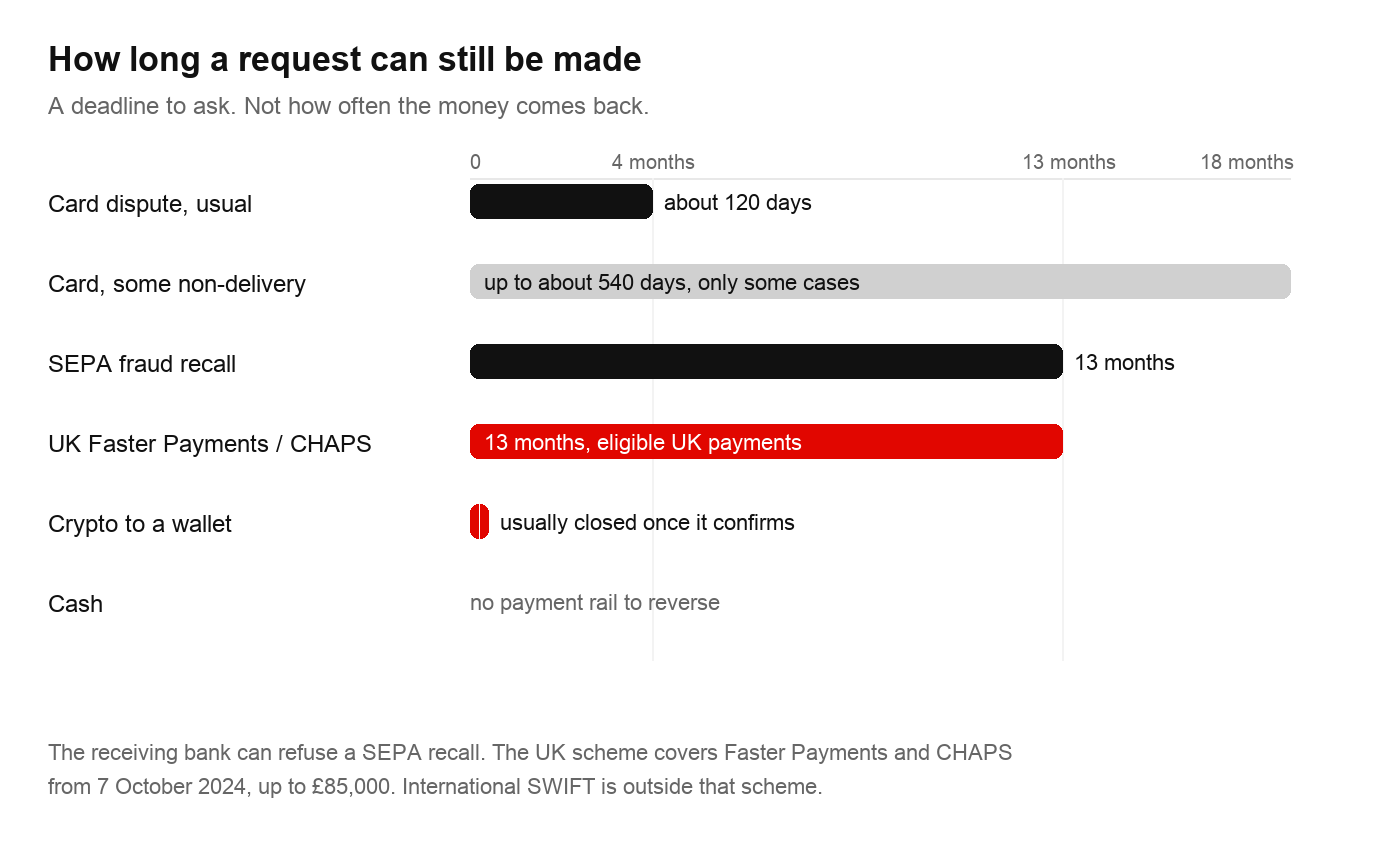
Visa and Mastercard disputes are usually filed by the bank within about 120 days of the transaction. Some non-delivery cases can run much longer, up to about 540 days. Those are scheme deadlines. A bank can ask you to write in sooner, and filing in time is not the same as winning. For a euro transfer inside SEPA, the European Payments Council rulebook lets the sending bank request a recall for a fraudulent credit transfer for up to 13 months. The receiving bank has to answer. It does not have to send the money back, and a recall started after the funds have moved on often comes back empty. An international SWIFT transfer has no card-style right of reversal at all. The practical hope is that the money is still sitting at the beneficiary bank when your bank calls.
The red bar on that chart is narrower than it looks. In the United Kingdom, the Payment Systems Regulator’s reimbursement rules cover eligible Faster Payments and CHAPS transfers made on or after 7 October 2024. You report to your own bank, within 13 months of the last payment, and the scheme cap is £85,000. International wires are outside it. The screen does not ask which country you are in, so a bank-transfer result only points UK readers at the United Kingdom help page.
Crypto sits at the other end. The US Federal Trade Commission says cryptocurrency payments typically are not reversible: you get the coins back if the person you paid sends them back. Contacting the exchange or cash-machine operator immediately is still worth doing, because that firm may still be holding something. Once a transfer has confirmed to an outside wallet, the chain does not run a chargeback. Cash never had a rail to begin with.
The second chart is the screen itself. Same bands the page uses. Read them as “how open is this route”, not “how likely is a refund”.
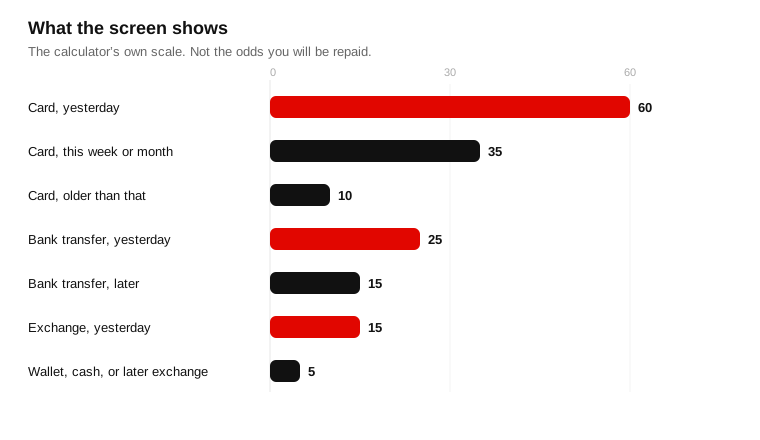
A card payment yesterday scores about 60 because that is when a dispute is most worth phoning in. The same card later in the week or the same month sits at about 35, while the usual 120-day window is still the relevant one. Older than that, the screen drops to about 10: ask the issuer, and do not assume a non-delivery exception applies to you. A bank transfer yesterday is about 25. Later, while a SEPA recall can still be requested, it is about 15 — the request exists, the money often does not. An exchange deposit yesterday is about 15, and only if the coins may still be on that platform. A wallet transfer, cash, or an exchange deposit after that first day sits at about 5. If you have no statement, chat, or transaction id, the screen takes 5 off and stops at 5. Missing paperwork makes a dispute harder. It does not invent a route where the payment cannot be pulled back.
Whatever the number, the next day looks similar. Stop. Do not pay a “tax”, an “AML fee”, or anyone who says they can recover the funds for an upfront charge. Call the firm the money left from — card issuer, bank, or exchange — and say it was fraud. If the paper trail is thin, write down amounts, dates, names, and addresses while you still remember them. Then use the official routes on Get help. A stranger who appears afterwards offering to get the money back for a fee is a separate problem, covered on Fake recovery.
If this matches what happened to you, start with the recovery chance screen, then Get help. Cold “we can get it back” offers belong on Fake recovery.
General information only, not legal or financial advice. Deadlines and bank rules change. If you lost money, contact your bank and the authorities through the help pages.