The letter is from a college you never applied to. Or it is from a loan servicer, about a balance you never signed. Or your own application for aid comes back refused, because someone has already used the year. Prosecutors call the stand-in a ghost student. The person whose name is on the form is real. The student in the classroom, if there is a classroom, is not.
The US Department of Justice says the play has been running since at least 2021. A stolen name and a Social Security number go onto a Free Application for Federal Student Aid. The "student" is enrolled, often at a college with open admissions and online classes, where nobody is going to notice an empty chair. Tuition is paid to the school first. Whatever is left of the aid is refunded, and the refund goes to a bank account the named person does not control.
How it works
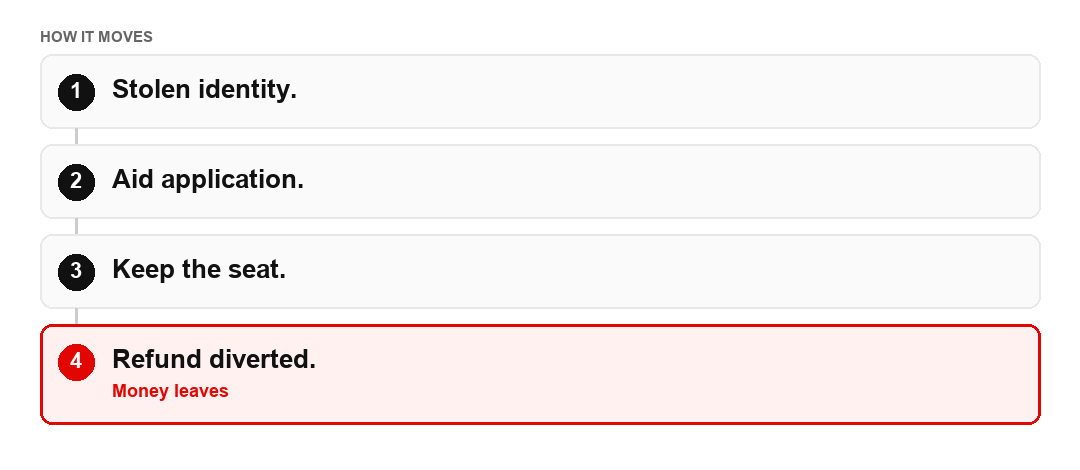
- A name and a Social Security number are bought or stolen, sometimes blended with invented details. A FinCEN alert of 24 July 2026 says artificial intelligence is used for the paperwork and, later, the coursework. FinCEN is the US Treasury bureau that tells banks what fraud to watch for.
- A federal aid form is filed and the "student" is enrolled, often on an online course at a college that accepts applicants without a long selection.
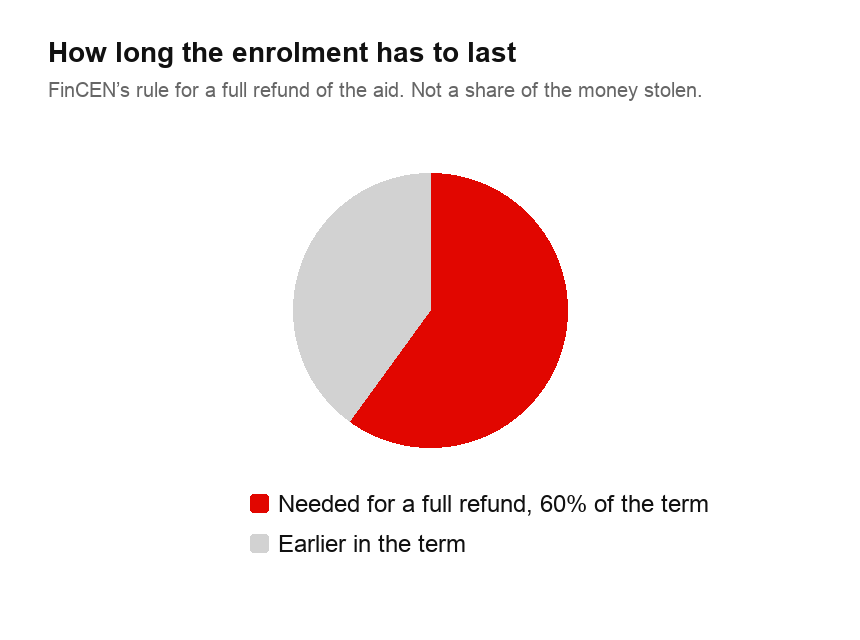
- The school is paid first. A full refund of the leftover aid needs the enrolment to last through 60 per cent of the term, the same alert says, so a chatbot or a paid stand-in keeps the class record alive. The 60 per cent is a refund rule. It is not a share of the money stolen.
- What is left lands in an account the named person does not control. They find out when a bill arrives, or when their own application is refused. Minors have been enrolled the same way. A child does not have to have applied. The name is enough.
The seat has to look occupied, because an empty course gets the aid pulled back. That is why the scheme bothers with homework. A program, or a person paid to log in, posts enough that the college's system still thinks a student is there when the refund is calculated. The named person is not doing the homework. They are the name on the cheque that went somewhere else.
Signs and red flags
A college, a servicer or a lender writes about a course or a balance you do not recognise. A refund or a loan is tied to a bank you have never used. Someone asks you to "confirm" a student login, or to receive a payment and pass it on. Passing a payment on is how a real person's account gets used as the last stop, so the refund looks as if it landed with the student. Open-admissions and fully online programmes are the usual doorway, because there is no classroom where a missing person would be noticed.
Cases and figures
On the Justice Department's account of Operation Ghostbusters, the FBI had identified more than $32 million in losses from this family of schemes, with more suspected. In September and October 2026 investigators flagged 830,840 Federal Student Aid IDs as potentially fraudulent, tied to nearly $130 million, and asked for those IDs to be switched off. One crypto account linked to a Kenyan national was seized for over $750,000. These are charges and investigative totals, not a finished trial of every name involved. An ID switched off is an account stopped. It is not, by itself, a refund to the person whose name was used.
Separately, the Treasury said FinCEN had identified about $270 million in suspicious activity that might be connected to federal student-aid fraud, drawn from bank reports rather than from a single proven loss figure. Bank reports of suspicion and a prosecutor's loss total are different piles. Both say the refunds are large enough to see from outside. Neither one is a list of every person who got a letter.
What to do and where to report
If a school or a loan you never opened appears in your name, tell the college's aid office and the loan servicer, put a fraud alert on your credit file, and keep every letter. In the United States, report it to the FBI's Internet Crime Complaint Center at ic3.gov and to the Department of Education's inspector general. Do not send a "refund" on to a stranger, and do not pay a stranger who offers to wipe the debt.
If you were hit, start at Get help. Anyone who then offers to recover the money for a fee belongs with the warnings on Fake recovery.
This is general information, not legal or financial advice. The rules and the figures change. If money has already left, contact the bank and the authorities through the help pages.